I Got a Sell Signal. I'm Not Selling.
My old engine flipped risk-off yesterday. The new one held. 23 years of data explain the difference.. and what happens if THIS is the big one.
By Leon · · 5 min read
First sent to Tailwind Macro subscribers on July 29, 2026. Letters are published here 3 weeks later; members get the calls live.
Let’s not bury the lead: $SPY and $QQQ both closed down about -2% today after the Fed meeting. The tape was as ugly as it gets.
And I’ll tell you something else, because you deserve the full picture: the original version of my Macro Regime Engine.. the TradingView prototype I built before the production system, which I still keep running as a reference.. flipped risk-off as of yesterday’s close.
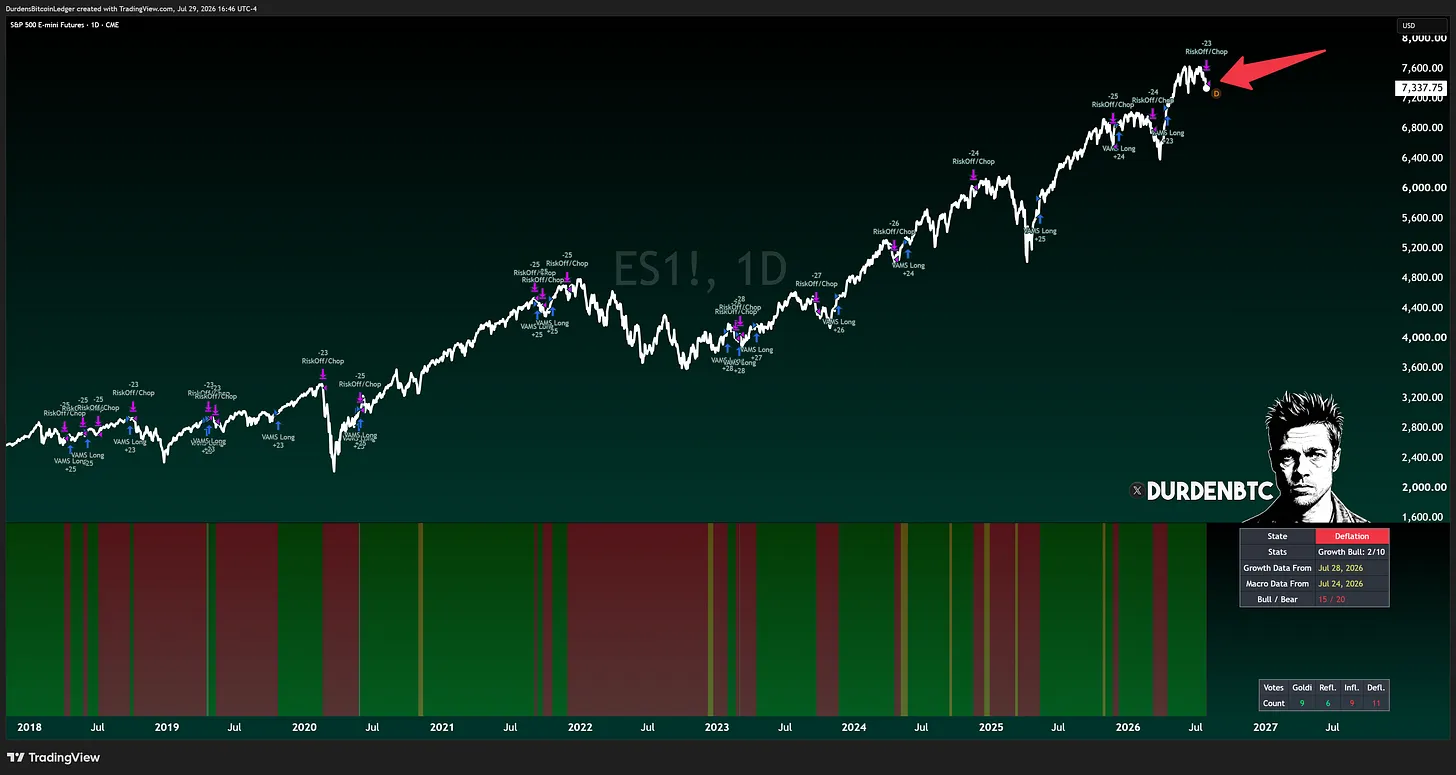
Meanwhile, the production engine.. the one that runs the actual portfolio.. is still Goldilocks, risk-on, with a Deflation challenger working on its 7-day confirmation clock (3 bars in, 4 more needed).
So the obvious question, and I know some of you are thinking it: is the new engine just slower? Are we the ones holding the bag?
I’ve spent the past 24 hours stress-testing exactly this.
Grab a coffee. Let me show you why I sleep fine.

Why the old engine flips first (and why that’s not a feature)
The TV (TradingView) prototype confirms a regime flip in 5 bars. Production takes 7, runs 26 voters instead of 22, and adds a half-exposure state plus a price-action handbrake the prototype never had.
So yes.. the old engine will always beat the new one to the exit. By design.
The question is whether that speed makes money. So I rebuilt the prototype’s entire 23-year trade history from its TV export and ran both engines against identical SPY prices. Same data, same dates, no excuses:

The two engines agree on 84% of days. Then there’s the number that settles the speed debate: across the 730 days where the old engine was out of the market and production stayed in, SPY returned +27% annualized.
Read that again.
Those days.. the ones where the fast engine “got safe” and the slow engine “held the bag”.. are where most of the outperformance gap comes from.
Ironic? Maybe. Profitable over 23 years of backtests? Certainly.
What the 7-day wait actually costs
So naturally your next thought might be:
“Okay, but while we wait for confirmation, we’re eating downside.”
I measured it. Across all 43 risk-off flips in 23 years, SPY’s move from the day a challenge started to the day the engine confirmed and stepped aside:
Median: 0.0%
Mean: -0.7%
Read that again, again (apologies for the superlatives but it’s important).
Half the time, the confirmation window costs nothing.. because most challenges start near local bottoms, and most of them die there.
The engine’s patience is a filter that has rejected dozens of head-fakes that flipped faster systems out at the lows.
And the scariest-looking case in that entire dataset makes the opposite point everyone assumes. In October-November 2008 (GFC), SPY fell -18.5% during one of these windows.. and the portfolio’s equity sleeve made +4.6% over the same stretch.
How? Because the system had already de-risked in September through its layered exits.. it was sitting at an average of 21% exposure while the market burned. The final “flip” was a formality. The protection had fired weeks earlier.
Which brings me to the layers.
If this IS the big one
The regime votes are one exit. They are not the only exit. Underneath them sits the Arsenal SPY handbrake.. a pure price-action engine that forces the equity sleeves to 0% the moment the tape breaks, no macro vote required.
Some of the longer-tenured subs might remember the “Arsenal suite” era.. if you’re new here, this is what the actual SPY Arsenal engine looks like:
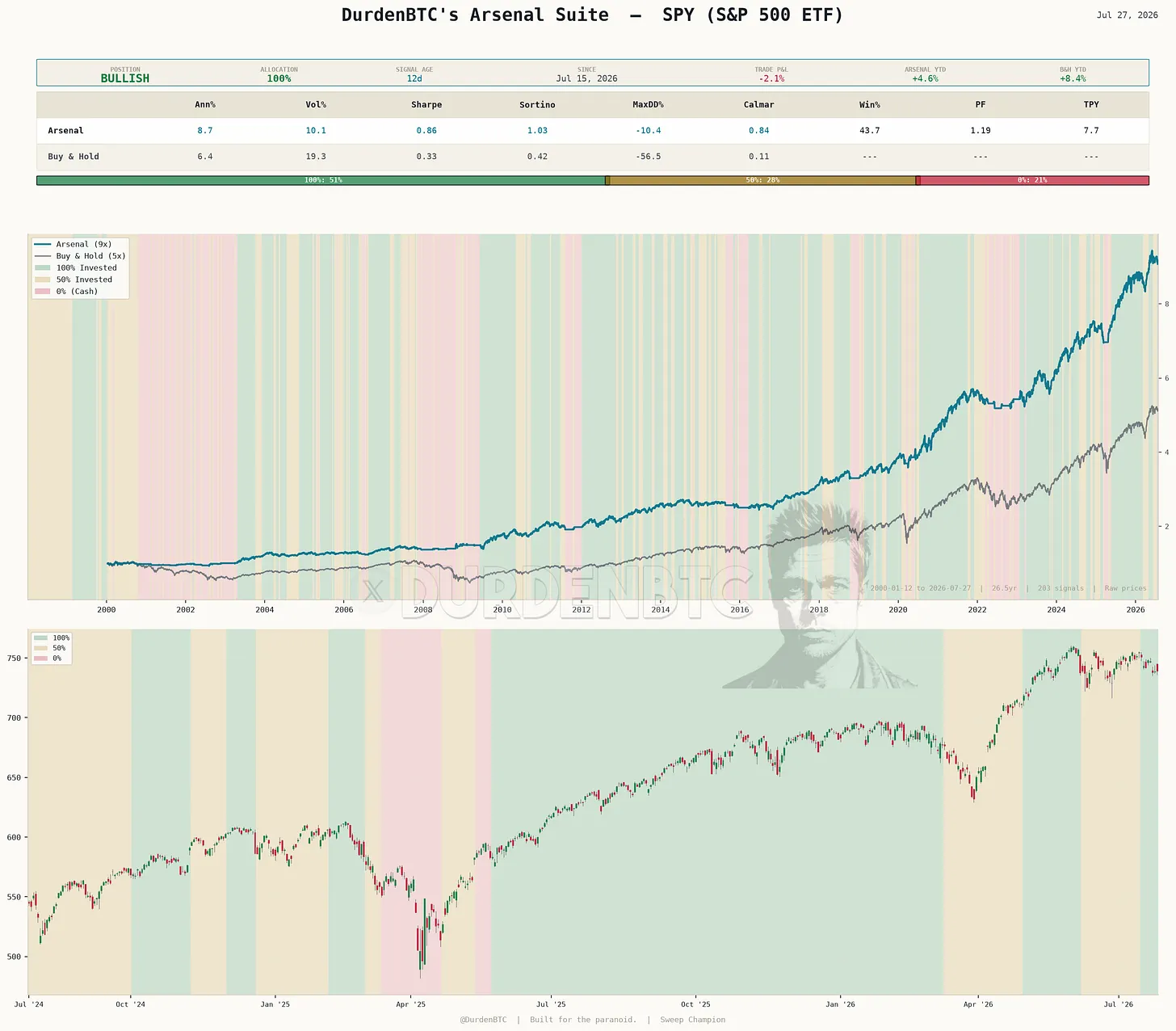
This week I audited it against every drawdown deeper than -13% in the modern record and asked one simple question:
Where was the handbrake when each one crossed the -13% line?
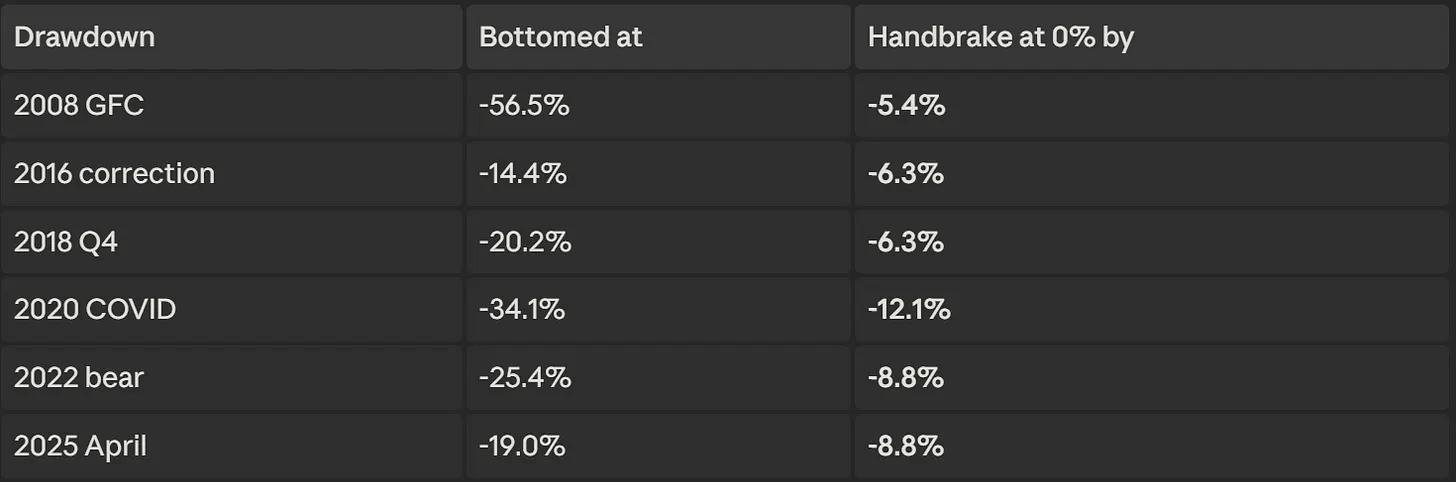
Six for six. Every major drawdown since 2007, the handbrake had us at 0% before -13%, usually between -5% and -9%.
Every real crash comes with a volatility explosion, and volatility is exactly what this engine eats.
One honest caveat, because I don’t sell perfection here: the single tape that beats the handbrake is a slow, orderly grind lower.. no vol expansion, ever.
In 23 years, no >-13% drawdown has looked like that. They all get disorderly.
And if one someday doesn’t, the macro regime layer above it is an independent exit.
That’s the point of defense in depth: today we’re one -2% day into a 3-day challenge, and there are three separate mechanisms between here and a portfolio-level disaster.. the regime votes, the handbrake, and the half-states in between.
As of tonight, QQQ also runs its own handbrake (a separate post will be published on this upgrade later), so a tech-led break gets caught even earlier.
What the internals actually say
Last thing, because this one surprised me. The bearish vote pressure everyone can see on the dashboard.. bear regimes (23) out-voting bull regimes (14).. I tested it as a signal across the full history.
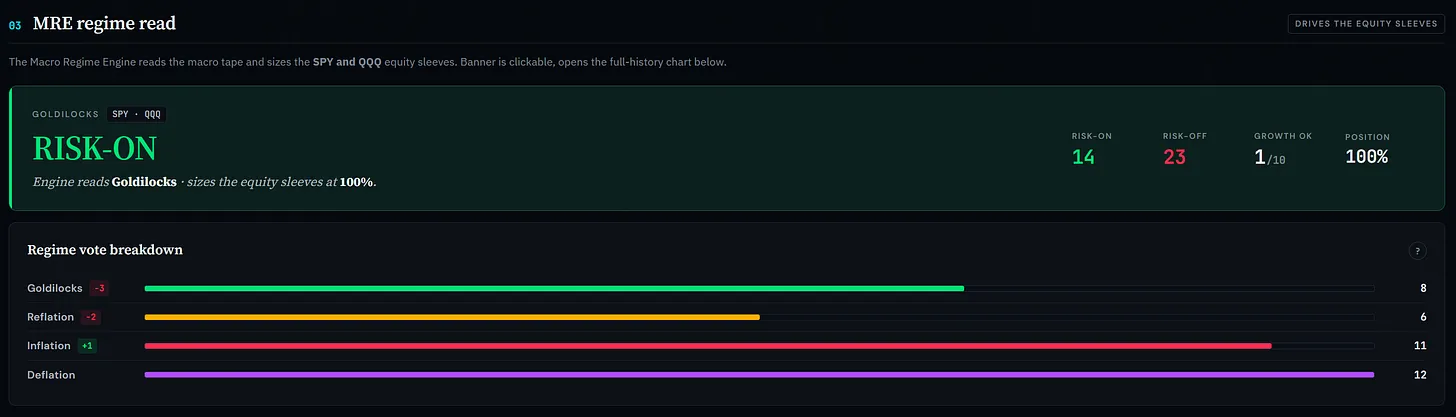
When the bear-vs-bull vote margin gets extreme while the engine is still risk-on.. forward returns have historically been among the best in the sample, not the worst.
Extreme fear inside a confirmed bull regime marks pullback bottoms far more often than crash beginnings. The single most extreme reading in 23 years printed three weeks from the exact bottom of the 2022 bear.
Four months ago, March of this year.. we lived this exact setup: bear votes crushing bull votes for sixteen straight days, the challenger clock running, everyone certain.
The engine never flipped & SPY was +12% over the next three months.
Sometimes it is February 2020, and the engine flips and steps aside.. that’s what the 43 flips in the dataset are. But the math says you don’t front-run the clock. You let it work.
The plan (there is no plan B, that’s the point)
If the bears keep winning the daily vote, the engine confirms in a handful of bars and we step aside.. at a median historical cost of roughly zero, with the handbrake armed underneath the whole way down.
If the challenge fizzles like March did, and like most do, we keep the exposure everyone else just panic-sold.
Both branches are fine. Neither involves me making a call at 2AM just because ES futures look scary.
The portfolio’s historical max drawdown through everything above.. 2008, COVID, 2022.. is about -10%.
Today’s -2% barely registers on the portfolio chart (down -3.4% at the portfolio level as of today’s close.. see for yourself below, I ran the pipeline locally while writing this post).
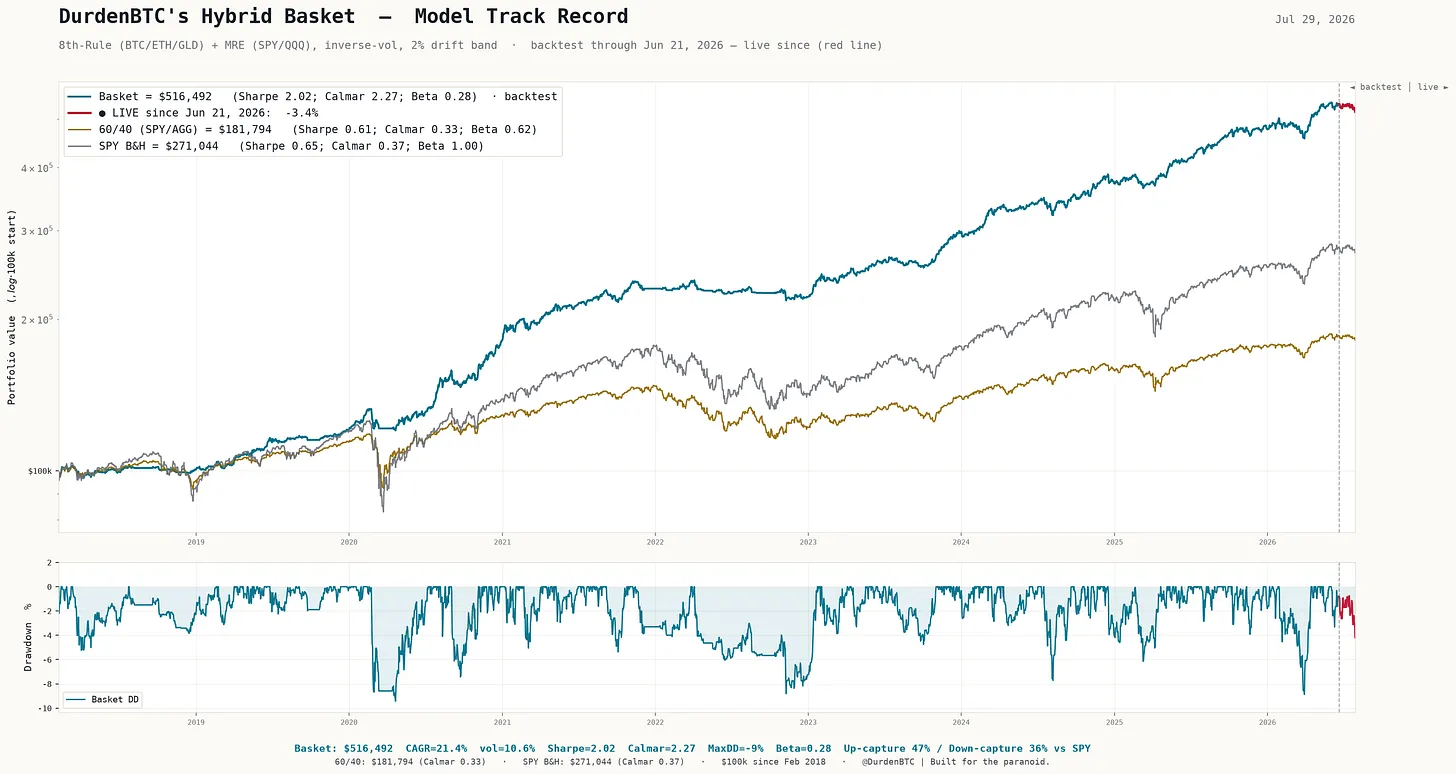
No vibes. No overrides.
The system does the worrying so I don’t have to.
I hope this deep-dive into the Macro Regime Engine gives you some confidence on a brutal day (and honestly brutal few weeks, especially for tech) that the system will do it’s job.
And trust me when I say this: I feel the pain.. probably even more so than most because I had the unfortunate timing (as usual) of rebalancing my portfolio (adding the QQQ sleeve and cutting exposure in SPY) on the exact day (June 22nd) where tech began underperforming massively against SPY:
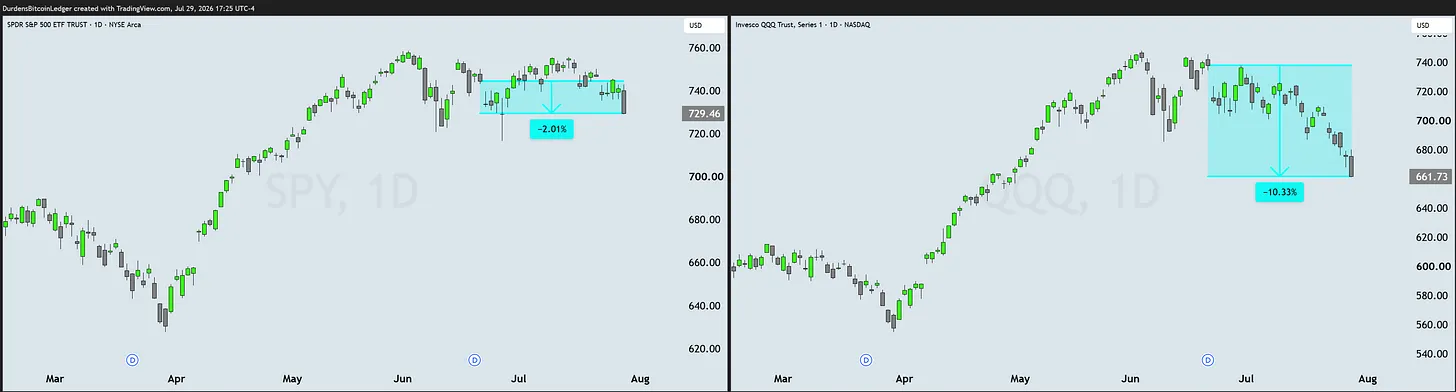
Survival is alpha.. and we will live to fight another day.
— Durden out.
✊🧼
Disclaimer: This content is for educational and informational purposes only. It does not constitute financial advice, investment advice, or a recommendation to buy or sell any asset. Trading equities and futures involves substantial risk of loss, including the potential for loss exceeding your initial investment.
Past performance, whether backtested or live, does not guarantee future results. Backtested performance has inherent limitations: it is designed with the benefit of hindsight, does not reflect actual trading, and does not account for all factors that may affect real-world execution.
The author is not a licensed financial advisor. Always do your own research and consult a qualified financial professional before making investment decisions. You are solely responsible for your own trading decisions.
Research and education, not investment advice. See the disclaimer.