Issue #58: A Cataclysmic Portfolio Upgrade
I froze the original 8th rule settings.. no per-asset tuning, no curve-fitting.. and it matched the engines I spent months hand-building. Here’s why that’s the most important test I’ve ever run.
By Leon · · 12 min read
First sent to Tailwind Macro subscribers on June 21, 2026. Letters are published here 3 weeks later; members get the calls live.
This weeks issue is going to be.. different. I’m overhauling my approach; again.
Not because I’m bored.. not because I like causing mayhem for all of you.. but because I genuinely believe this approach is stronger and more robust going forward than anything I’ve released before.
I’m also extremely brutal in my self-review.. some of the conclusions I came to were.. well, we’ll get to that.
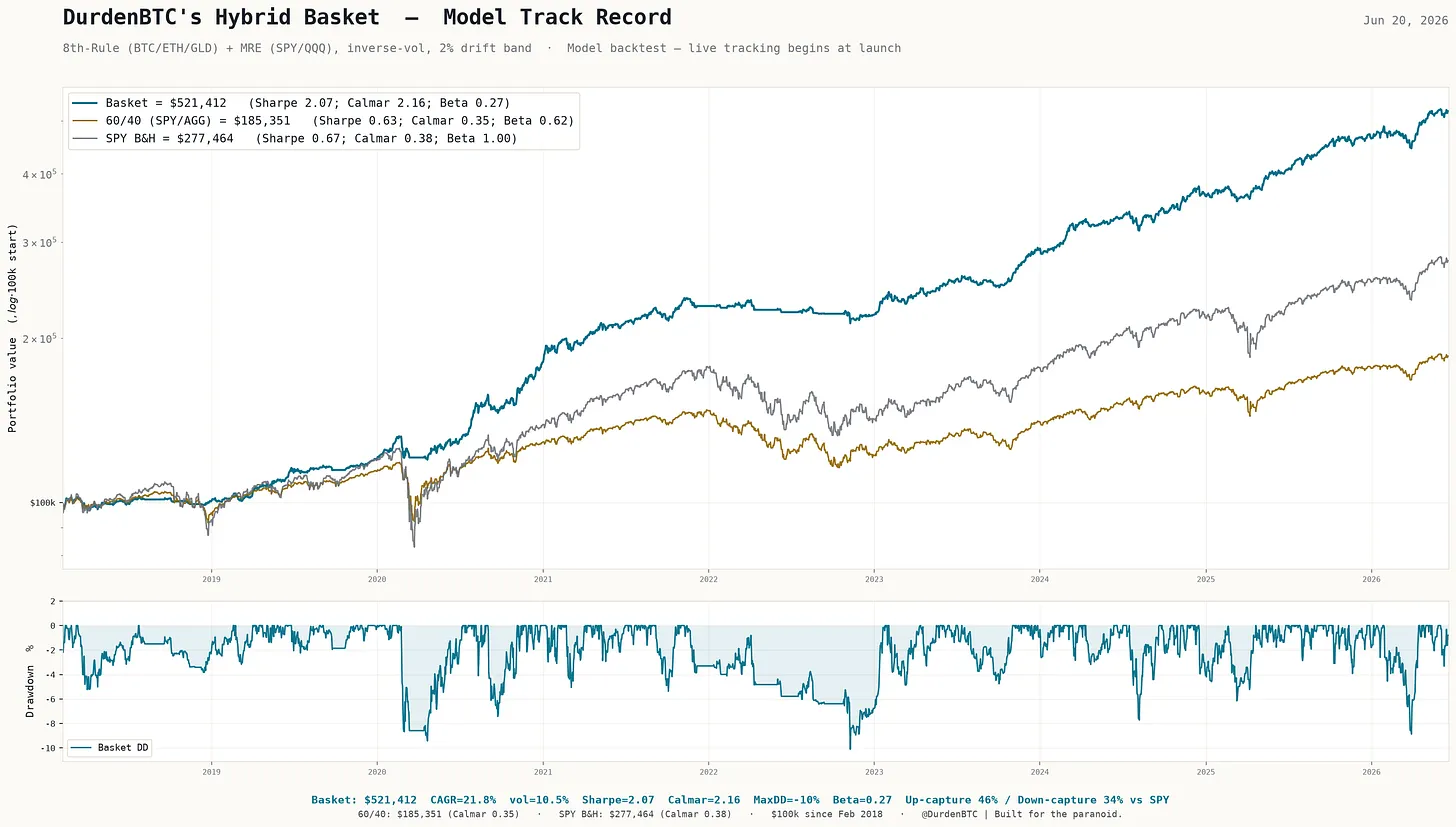
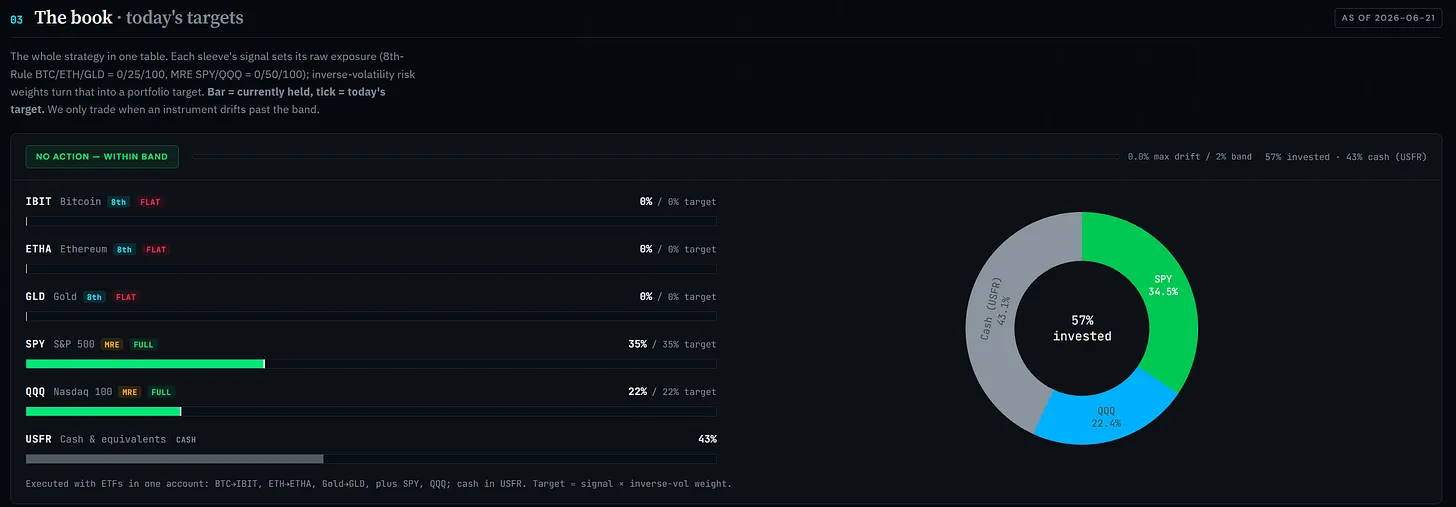
First, since this is a long post.. let me share this one chart first.. we’ll come back to it later; I’ll explain it all in context.
If you’d rather watch a video of my brain-dump around all of these changes than read a long article.. go for it:
Otherwise strap the fuck in, grab a coffee.. and let’s get into it.
TL;DR.. for the ones who won’t strap in (shame on you):
What I killed: the per-asset, hand-tuned Arsenal engines. The trend work on Bitcoin, Ethereum (yes, I’m bringing ETH back), and Gold now run on ONE frozen, un-tuned 8th rule config.. the same knobs on all three.
The old book: a static 60/20/20.. 60% SPY, 20% Gold, 20% Bitcoin. Set it, ignore it, rebalance once in a blue moon. In the trash.
The new book: five sleeves.. BTC, ETHrestored, Gold (frozen 8th-Rule) plus SPY and QQQnew (the MRE).. each sized by its own volatility into one dynamic portfolio that breathes.
Cash continues to park in USFR and gets paid to wait.
Why I bothered: I proved the Arsenal tuning was never the edge. The 8th rule edge is structural.. the portfolio layer, not the parameters.
The honest part: the new basket does not beat the old one. Head-to-head it’s a coin flip.. the old one’s even a hair ahead on raw numbers.
I’m switching for robustness, not returns. Those numbers that are “ahead” have a huge asterisk (I get into this later).
Half the trades, half the knobs, one config I can defend in a downturn.
What changes for you: you’ll hold two new tickers (ETHA, QQQ), and you’ll rebalance ~45 times a year instead of ~never.. but only when something drifts >2% off target. The portfolio is now dynamically allocated based on a rolling 90-day inverse volatility formula.
Full mechanics in Phase 6 below.
With the TLDR out of the way.. let’s get into the actual article.
Phase 0: A Splinter That Won’t Surface
A few weeks ago I tore the Arsenal engines apart and rebuilt them with an opinion. Out with the permanent 50% neutral position, in with a system that goes fully long when the trend is its friend and fully to cash when it isn’t.
I told you the reasoning, cut and dry: the signal gets to be a race car because the portfolio is the seatbelt.
I believed it. I still do.
But belief isn’t proof, and that gnat in the back of my skull doesn’t care what I believe. It kept asking one question I couldn’t answer cleanly:
If the edge really lives at the portfolio layer.. then why am I hand-tuning a separate engine for every single asset?
“The things you own end up owning you.”
Three months of my life were owned by parameter sets. A Hull length for Bitcoin. A different one for Gold. Bespoke thresholds, bespoke confirmation bars, each one lovingly fit to the history of the asset it sat on.
It looked like rigor. It felt like work.
It was also the exact thing I warn you about every week: a curve, fit to noise, and I knew better..
Phase 1: The Vanity of the Knob
Here’s the uncomfortable truth about tuning an Arsenal engine per asset. When you optimize Bitcoin’s parameters on Bitcoin’s (full) history, you are by construction fitting to the path that already happened.
You will always find a setting that looks brilliant in the rearview.
The market is generous like that. It hands you a perfect answer to last year’s test and charges you the tuition next year.
So I asked the one question that actually settles it. Not “what’s the best config for Bitcoin?” That question is rigged. The honest question is:
Does the signal need the tuning at all?
If my whole thesis is true.. that the trend is the edge and the portfolio is the risk control, then a single, frozen, un-tuned configuration should hold up across completely different assets.
Same knobs on Bitcoin, on Ethereum, on Gold.
No adjustments. No “well, crypto is different.”
If it falls apart, my thesis was a story I told myself. If it holds.. then the per-asset tuning was vanity all along.
There was only one fair way to test it. Go back to the beginning.
Phase 2: Setting It Free (for real this time)
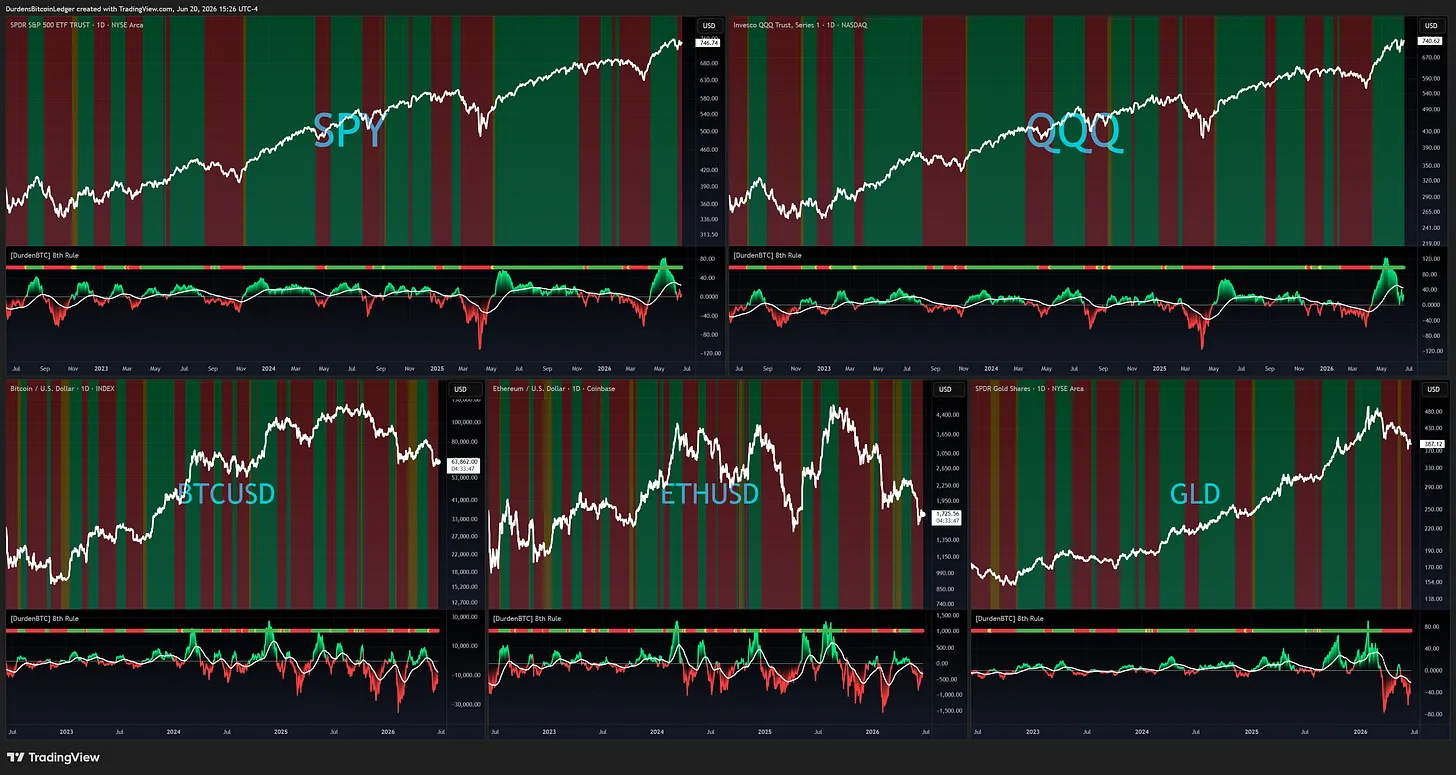
The original 8th Rule.. the Hull-and-Gaussian engine that started this entire publication has one set of parameters. I locked them. One config. I’ll call it the frozen config. Then I pointed it, completely unchanged, at three assets that have nothing in common:
Bitcoin: reflexive, runs on liquidity, supply dynamics and animal spirits.
Ethereum: higher beta, messier, a different animal entirely.
Gold: the slow, ancient haven that trades NYSE hours in low-vol purgatory.
Same Hull length. Same Gaussian filter. Same bands, same thresholds, same everything. The kind of test that’s designed to embarrass you, because there is no hiding behind a knob. The config either generalizes or it doesn’t.
“It’s only after we’ve lost everything that we’re free to do anything.”
I was fully prepared to lose the comfortable belief that my hand-built engines were special.
Phase 3: The Result That Should Scare You (it’s good news)
The frozen config, un-tuned, printed numbers in the same neighborhood as the per-asset engines I’d sweated over for months. On some assets a hair better, on some a hair worse. Functionally: a tie.
Sit with that, because it’s the whole post.
If a single frozen config matches a stack of individually hand-tuned ones, the tuning was never the edge. Every hour I spent optimizing per-asset parameters was buying a rounding error and a false sense of mastery.
The thing actually doing the work was the structure.. ride the trend, refuse to chase a bounce inside a drawdown, and let the portfolio do the sizing.
That structure doesn’t care whether it’s looking at $BTC or $GLD. It’s the same physics.
This is the difference between a system and a story. A story needs a special parameter for every asset, because the story is really just a memory of what worked.
A system uses the same logic everywhere, because the logic is the point.
The frozen config trades less, too.. Bitcoin went from ~26 round trips a year on the old tuned engine down to ~13 on the frozen one. Fewer trades, fewer knobs, fewer ways to fool myself.
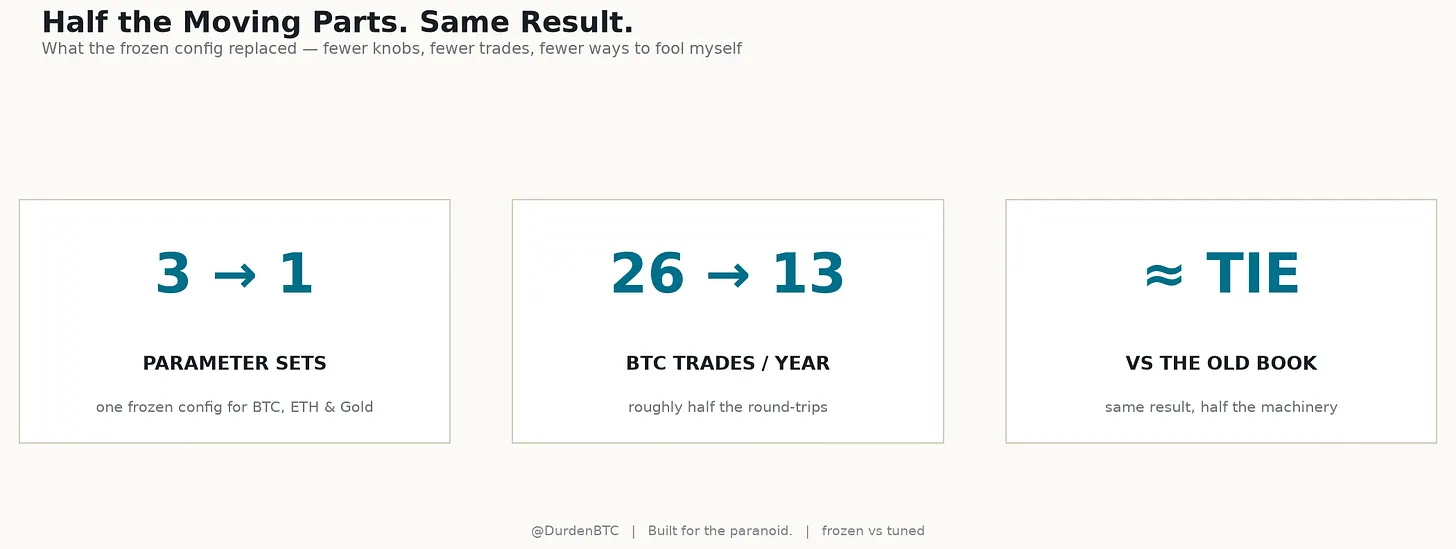
Half the moving parts for the same result is not a downgrade. It’s the upgrade.
Phase 4: Now Prove It Isn’t Luck
A tie on the in-sample history is nice. It’s also exactly what an overfit system looks like.. right up until the moment it isn’t. A backtest only tells you what already happened.. not whether you earned it or fit it.
So I ran the tests that actually separate the two. All of them on the frozen config. None of them kind.
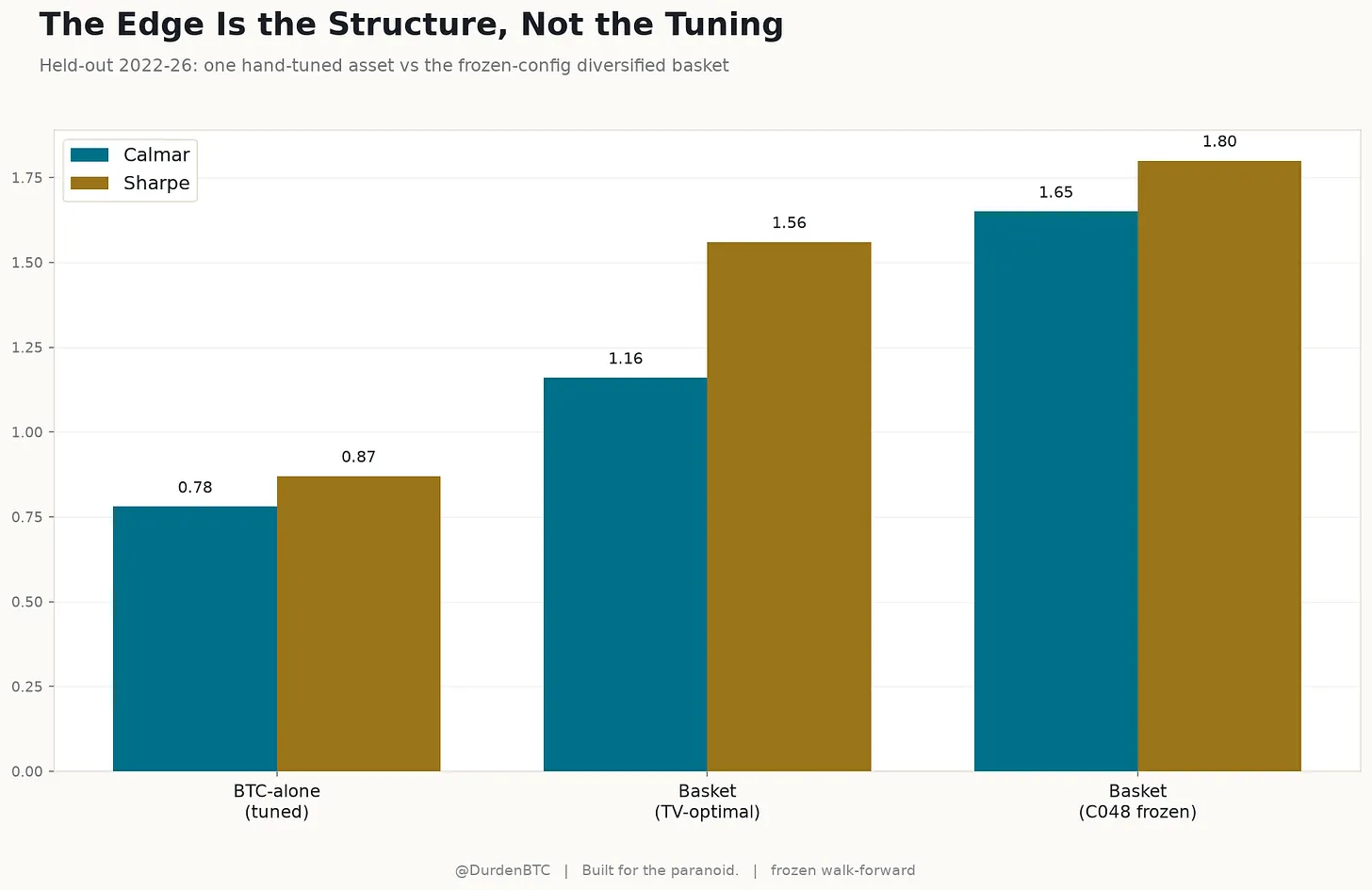
The blind test. I locked the config on everything through 2021, then turned it loose on 2022-to-today.. an era it had never seen. No peeking, no re-tuning. A single tuned asset, Bitcoin alone, limped in at a 0.78 Calmar out of sample. The same frozen config, diversified and vol-sized into the basket, more than doubled it.. 1.65, on data it was never shown.
The lift didn’t come from the knobs. It came from the structure.
The monkey test. Now this is where it gets interesting so stick with me here.
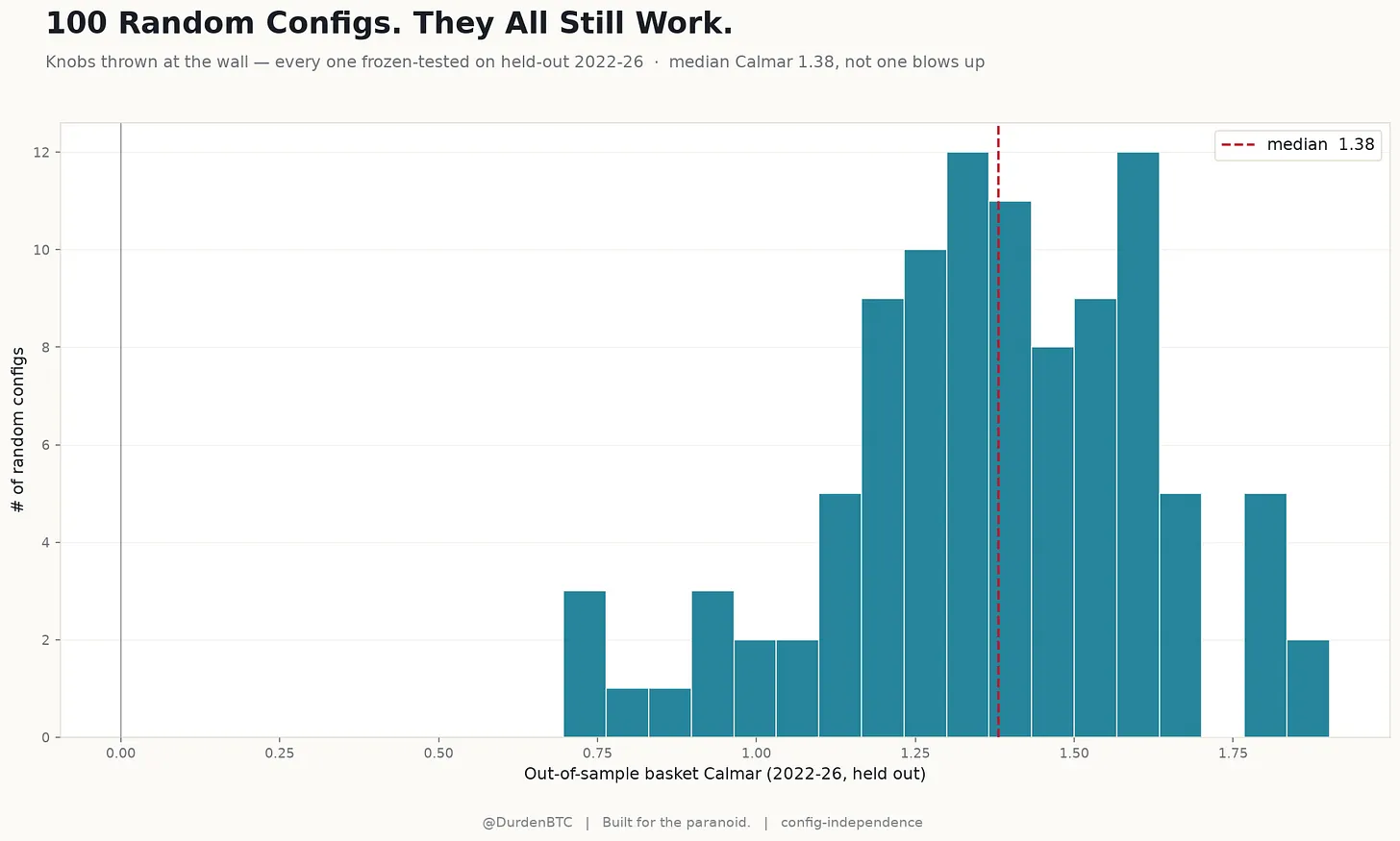
I went after my own config. I generated a hundred random parameter sets.. knobs thrown at the wall by a coin flip, and ran the basket on every one, out of sample.
If the edge lived in the tuning, the random configs would fall apart.
They didn’t.
Every single one landed in a profitable, positive-Calmar band, median around 1.4. You can hand this system a config a monkey picked and it still works.. because, one more time for the people in the back.. the edge is structural, not fitted.
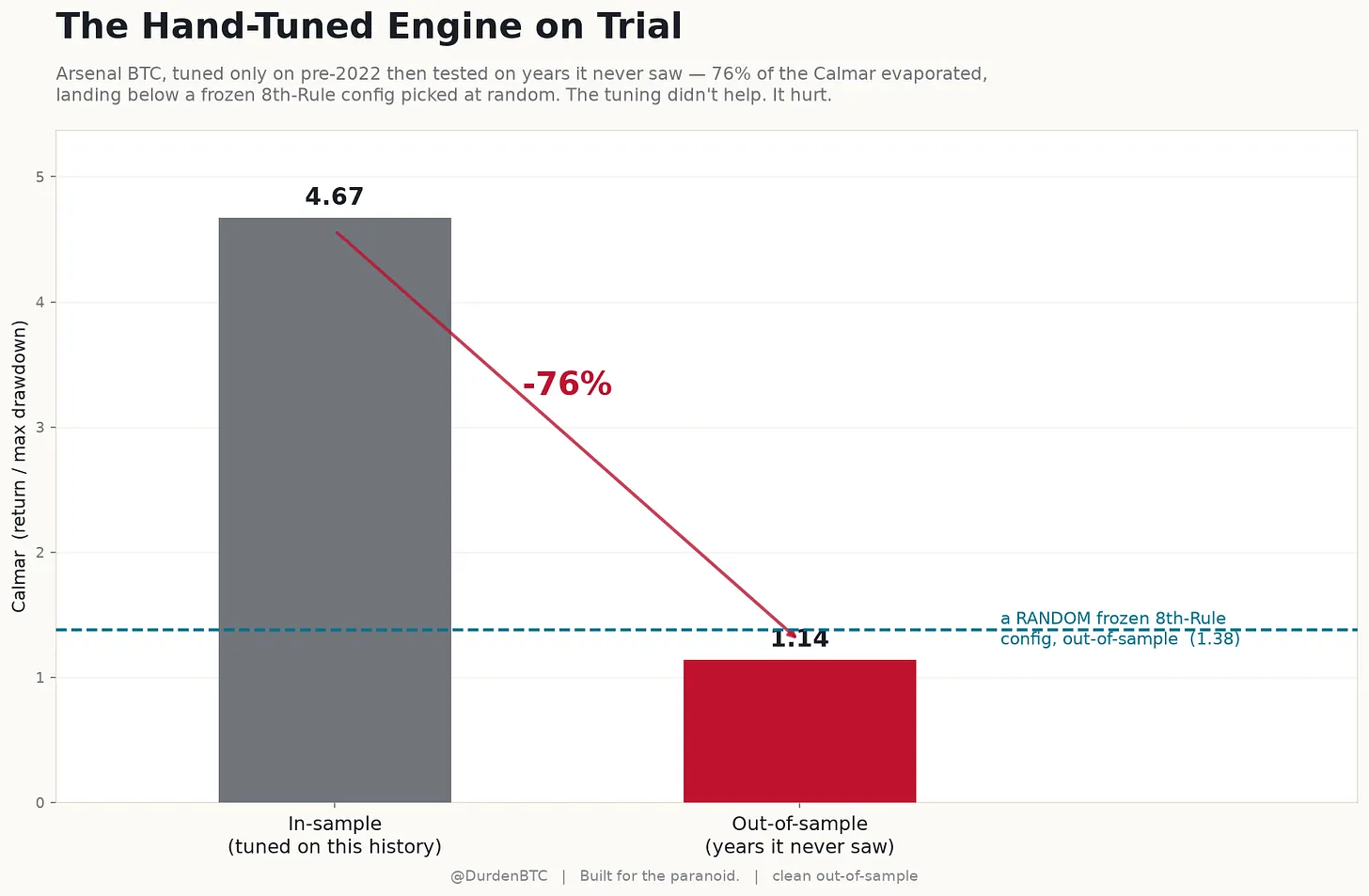
The autopsy. I put my old hand-tuned Arsenal engine on trial under the exact same clean rules. Tuned only on pre-2022 data, then tested on years it had never seen, my Bitcoin Arsenal engine gave up 76% of its Calmar.. and the version I’d optimized hardest did worse out-of-sample than the one I never touched.
It’s almost embarrassing to share this but I am nothing if not self-deprecating, brutal and absolutely ruthless in my critique of my own systems.
The months of tuning didn’t just fail to help. They actively hurt. That’s not an opinion anymore. It’s a number.
The hardest-tuned Arsenal config, tested honestly, landed below a frozen 8th-Rule config I picked at random. Read that again.
Everything I believed about my own mastery was a story the in-sample history told me.
And the sequencing? One last one.. because “it isn’t overfit” and “it wasn’t lucky” are different questions.
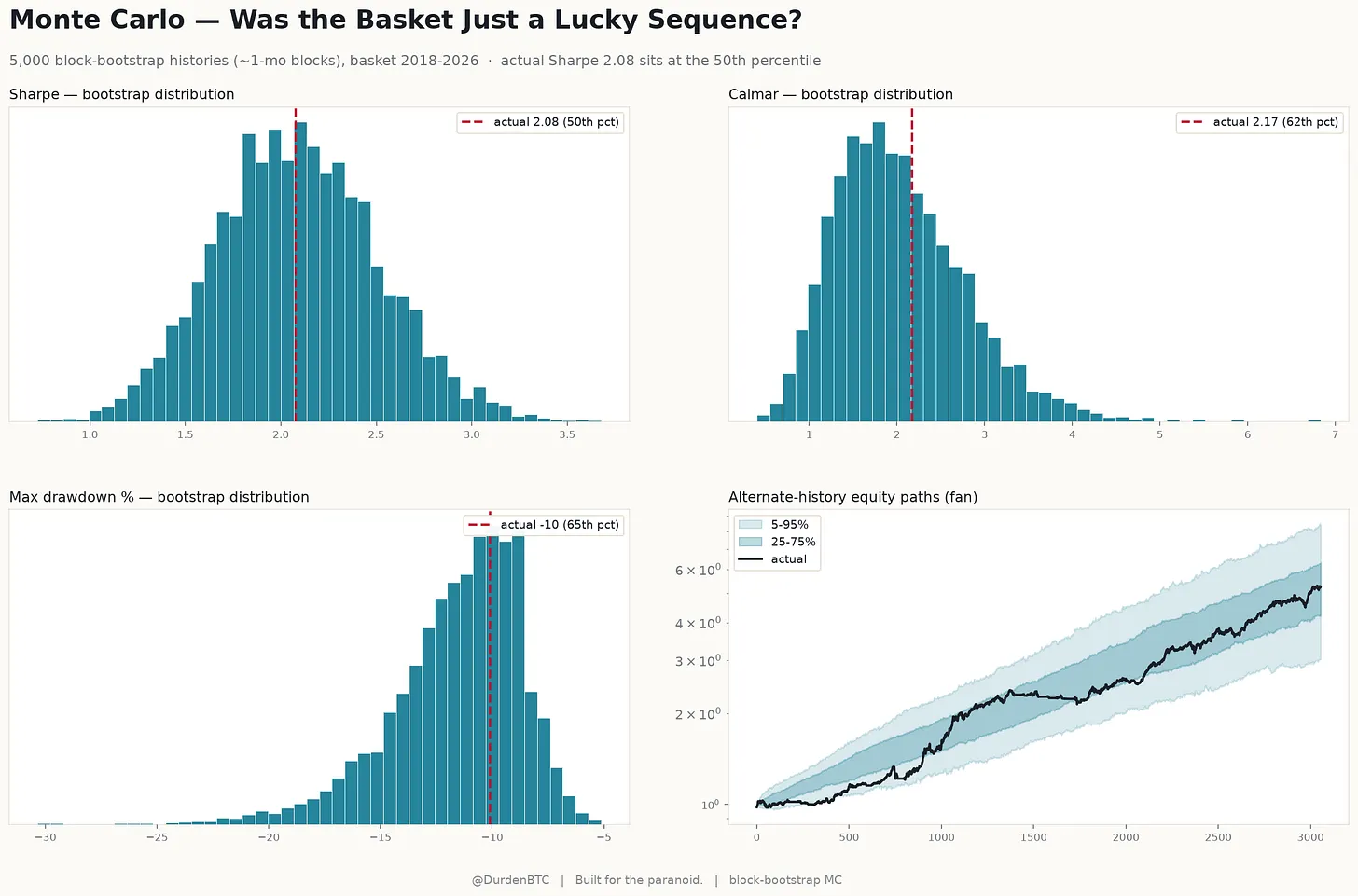
I reshuffled the basket’s history five thousand ways, keeping the monthly blocks intact so the momentum survived, and asked where the real result landed. Dead center.. the 50th percentile of every alternate history.
The trend sleeves are the 8th Rule now.
The equity core still leans on the Macro Regime Engine.. the 26-voter macro brain that’s run this publication from the start.. and it reads the Nasdaq as cleanly as it reads the S&P, which is exactly why QQQ is going into the book alongside SPY from this point out.
I’m not going to oversell a word of it. Calibrate to the honest floor, not the headline. Which brings me to the asterisk I’d never bury.
Phase 5: I Am Jack’s Inflated Sharpe Ratio (still)
The backtest on the new basket is, on paper, gorgeous. A hundred grand becomes ~$520k since 2018. Calmar above 2. A Sharpe north of 2. Beta of 0.27 to the S&P, downside capture of ~34%.
It looks like a slide a fund would frame.
It is also flattered, and I will tell you exactly how.
That window.. 2018 to today was a bull market in crypto, and in equities, and in gold, almost simultaneously. It did however also capture (and avoid) the COVID flash-crash and the mini-bear market in 2022.
A diversified trend book in a generalized three-way bull market is a fish in a barrel. A Sharpe of 2 is not your live expectation.
My own monitor bakes in the discount: plan for a live Calmar closer to 1.0–1.5 and a real drawdown in the −10% to −15% range, and treat anything better as a gift.
I’d rather you under-promise yourself and be pleasantly surprised than buy a headline I know is the exception, not the rule.
Phase 6: What This Means for You
The members area now runs on a stack I can defend without flinching:
One frozen 8th-Rule config does the trend work on Bitcoin, Ethereum, and Gold.. using the same settings, no per-asset curve-fitting.
The MRE.. still on version six with 26 voters, anchored to economic logic.. handles the equity core (SPY/QQQ).
The portfolio layer does the risk management, sizing each sleeve dynamically by its own volatility so no single bet can hijack the book.
And it’s all out in the open. No black box. The out-of-sample charts, the equity track record, the per-sleeve breakdown.. every one of them is on the site, styled to read at a glance, built so you can audit the logic instead of trusting the output blind.
What actually changes in your account
The old book was a static 60/20/20 — 60% SPY, 20% Gold, 20% Bitcoin. You set it, you maybe rebalanced once or twice a year, and otherwise you left it alone. Simple.
The new book is dynamic. Same spirit.. a handful of sleeves in one account.. but the weights breathe with the signals. In plain terms:
Six tickers, one book. Bitcoin is IBIT. Ethereum is ETHA. Gold is GLD. The equity core is SPY and QQQ. Cash sits in USFR.. a floating-rate T-bill ETF.
The signals decide who’s in. Each trend sleeve (BTC/ETH/Gold) is fully in, partially in, or in cash, per the frozen 8th-Rule. The equity sleeves follow the MRE regime. When a sleeve goes to cash, that weight flows to USFR.
Volatility decides how much. The sleeves that are “in” get sized by inverse volatility.. the calmer the asset, the bigger the slice. No single bet gets to run the book.
How you actually rebalance: this is the important part
Every morning the site publishes the target book: the exact target % for each ticker, what you’re currently holding, and a single rebalance flag.
Here’s the rule that keeps this sane: you only trade an instrument when it drifts more than 2% from its target. Not every day. Not every wiggle.
Most mornings nothing is flagged. You do nothing. You close the tab.
When something drifts past the 2% band, the flag flips. You adjust only that instrument back to target.. buy or sell the difference.. and leave everything else alone.
In practice that’s about 45 rebalances a year.. call it once a week on average, usually clustered around the big moves. More hands-on than set-and-forget 60/20/20, nowhere near day-trading.
Check it with your morning coffee and you’ll never miss the band. Every drift/rebalance/trade will still be published with it’s own Substack post.
A snapshot, as I write this
Right now the book is defensive: Bitcoin, Ethereum, and Gold are all flat.. so roughly 57% sits in SPY and QQQ and ~43% is parked in USFR earning yield.
I will be doing my rebalancing at market open tomorrow (Monday, June 22nd).
One caveat I won’t bury: ~45 rebalances a year means more taxable events than buy-and-hold. In a taxable account, that’s short-term gains.. factor it in, or run it somewhere tax-advantaged if you can. I’d rather you know that now than find out in April.
And calibrate to the floor from Phase 5, not the backtest: plan for a live Calmar around 1.0–1.5, drawdowns in the −10% to −15% range, and stretches where you watch the S&P run without you.
A final note
Am I switching because the new basket crushes the old one? No. I’ll be straight, like always: head-to-head, the frozen-config basket and my old hand-tuned portfolio are a coin flip.. the old one is even a hair ahead on raw numbers.
I’m switching because the new one is honest. Fewer parameters to overfit. Half the trades. One config I can explain to you in a paragraph and defend in a downturn.
I will trade a flawless line built on a hundred secret knobs for a slightly uglier one I actually understand, every single time.
“You are not your job. You’re not how much money you have in the bank.”
And your edge is not your parameters. It never was. It’s the discipline underneath them.. ride the trend, respect the drawdown, size like you’ll be wrong, and let the portfolio carry the risk so the signal doesn’t have to.
We froze the knobs. We ran it blind. It held.
— Durden out.
✊🧼
Disclaimer: This content is for educational and informational purposes only. It does not constitute financial advice, investment advice, or a recommendation to buy or sell any asset. Trading equities and futures involves substantial risk of loss, including the potential for loss exceeding your initial investment.
Past performance, whether backtested or live, does not guarantee future results. Backtested performance has inherent limitations: it is designed with the benefit of hindsight, does not reflect actual trading, and does not account for all factors that may affect real-world execution.
The author is not a licensed financial advisor. Always do your own research and consult a qualified financial professional before making investment decisions. You are solely responsible for your own trading decisions.
Research and education, not investment advice. See the disclaimer.