My System Exited the S&P 500 the Week Before COVID Crashed the Market.
Most investors rely on headlines. This system relies on math. A breakdown of the raw momentum data that forced a defensive exit 23 days before the bottom.
By Leon · · 3 min read
First sent to Tailwind Macro subscribers on February 3, 2026. Letters are published here 3 weeks later; members get the calls live.
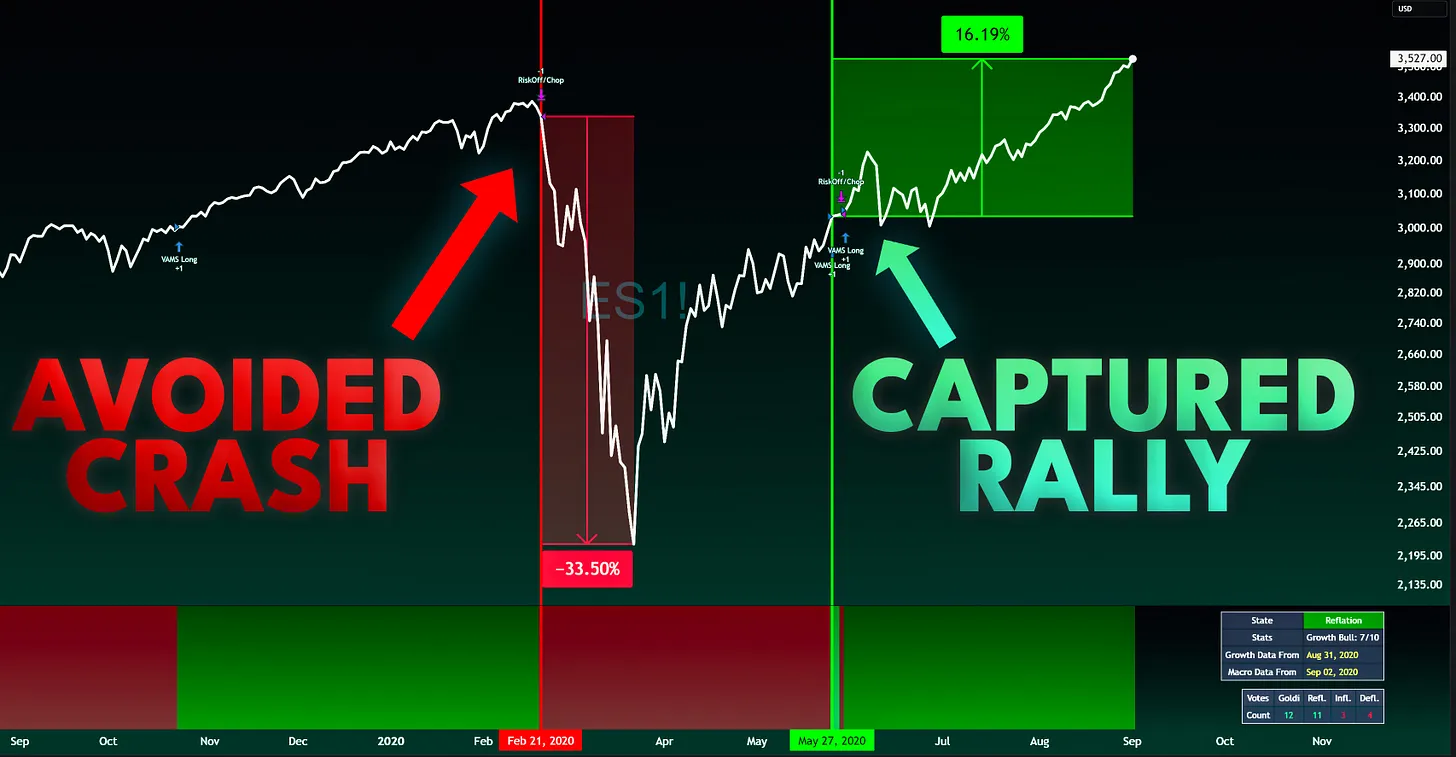
In February 2020, my Macro Regime Engine, a system that reads momentum signals across global equities, bonds, currencies, commodities, credit, and volatility to classify the macroeconomic environment.. exited its long position in the S&P 500.
The date was February 21st, 2020.
Over the following 23 trading days, the S&P 500 fell 34%.
The system didn’t predict COVID. It didn’t know a pandemic was coming. Nobody did.
What it did was something much simpler: it measured that the global macro environment had turned hostile.. across multiple independent asset classes, simultaneously, and it stepped aside.
This post walks through exactly what happened.
The Setup: October 2019 – February 2020
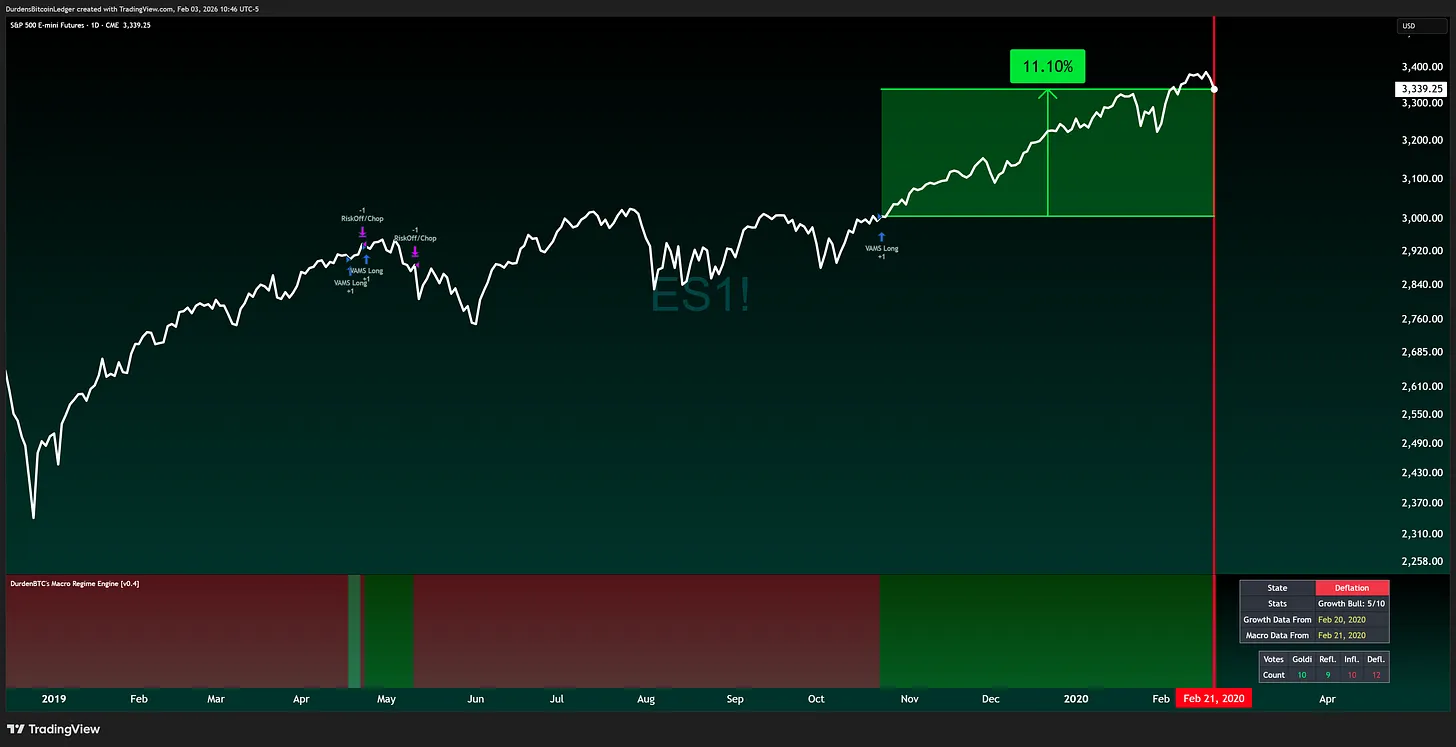
The system had been long since October 22, 2019. The macro regime was favorable.. growth assets were broadly bullish, volatility was suppressed, credit spreads were tight. Standard Goldilocks conditions. The trade was working. By mid-February, it was up roughly 11%.
Nothing on the S&P 500 chart alone suggested trouble. Price was at all-time highs. The 50-day moving average was sloping up. RSI was fine. If you were using any standard single-chart technical system, you had no reason to sell.

But the Macro Regime Engine doesn’t look at one chart. It listens to the entire global financial system. And in the third week of February, what it heard was this:
Growth assets started cracking. Not just the S&P.. global equities began diverging. Some indices rolled over while others held. Risk-sensitive currencies weakened. Credit spreads started ticking wider.
Safety assets woke up. The dollar strengthened. Bond yields started falling. Volatility.. both equity (VIX) and bond (MOVE), began rising from suppressed levels.
The vote count shifted. The system aggregates these signals into a regime classification. In a healthy Goldilocks or Reflation regime, the vast majority of global markets agree that conditions are favorable. In the third week of February, that consensus broke. Enough assets had flipped from “bullish” or “neutral” to “bearish” that the regime could no longer sustain a Risk-On classification.
On February 20th, 2020, the system exited.
What Happened Next
The S&P 500 closed at 3,373 on February 19th.
By March 23rd, it hit 2,237. A 34% drawdown in 23 trading days.. the fastest bear market in history.
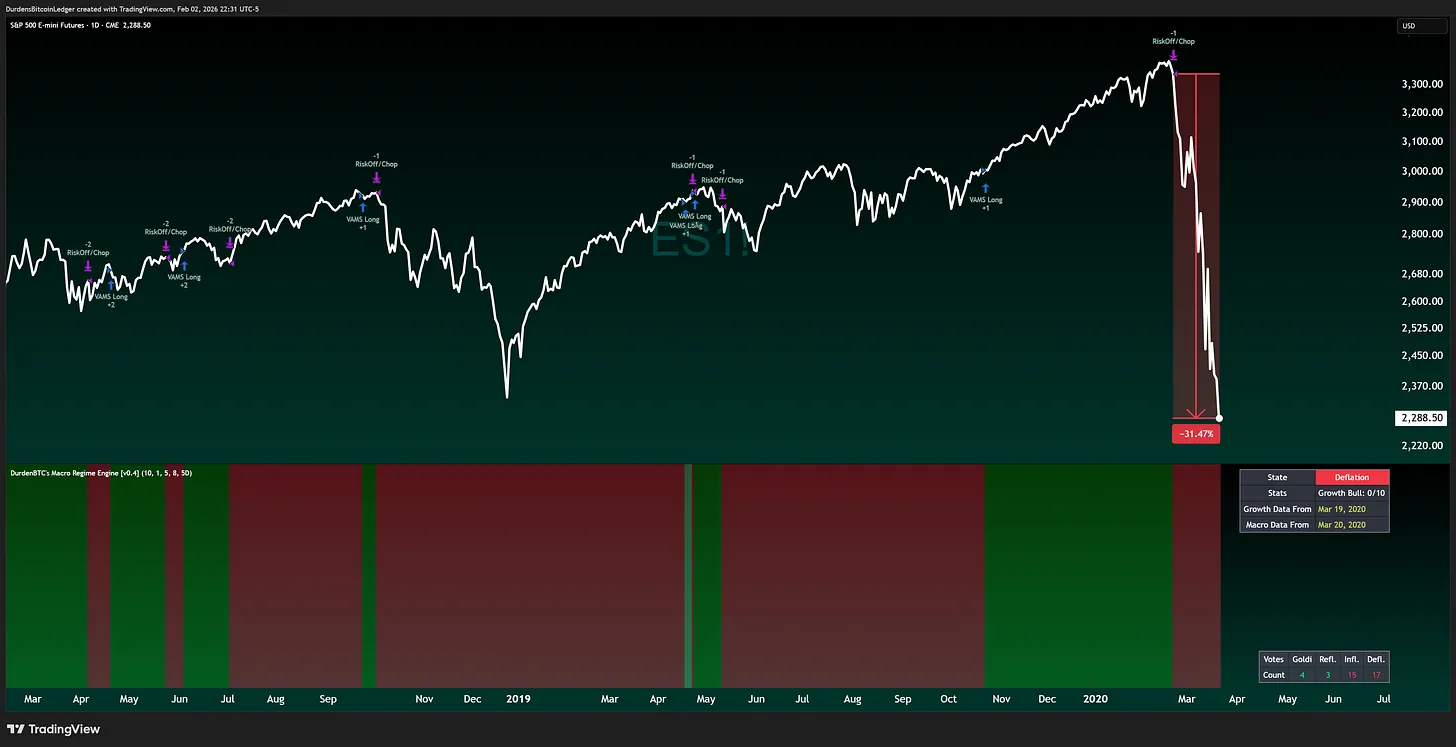
The system was in cash for the entire move.
The Recovery: Getting Back In
The system didn’t rush back in. Through March and April, while the market was bouncing violently off the lows, the macro breadth was still hostile. Growth assets were mixed. Volatility was elevated. Credit spreads were still wide. The vote count said: “this isn’t safe yet.”
By late May, that changed. Global equities had recovered enough breadth. Volatility was declining. Risk currencies were stabilizing. Credit spreads were tightening. The cross-asset picture shifted from “crisis” to “early recovery.”
The system re-entered on May 31, 2020. The S&P was at 3,054.
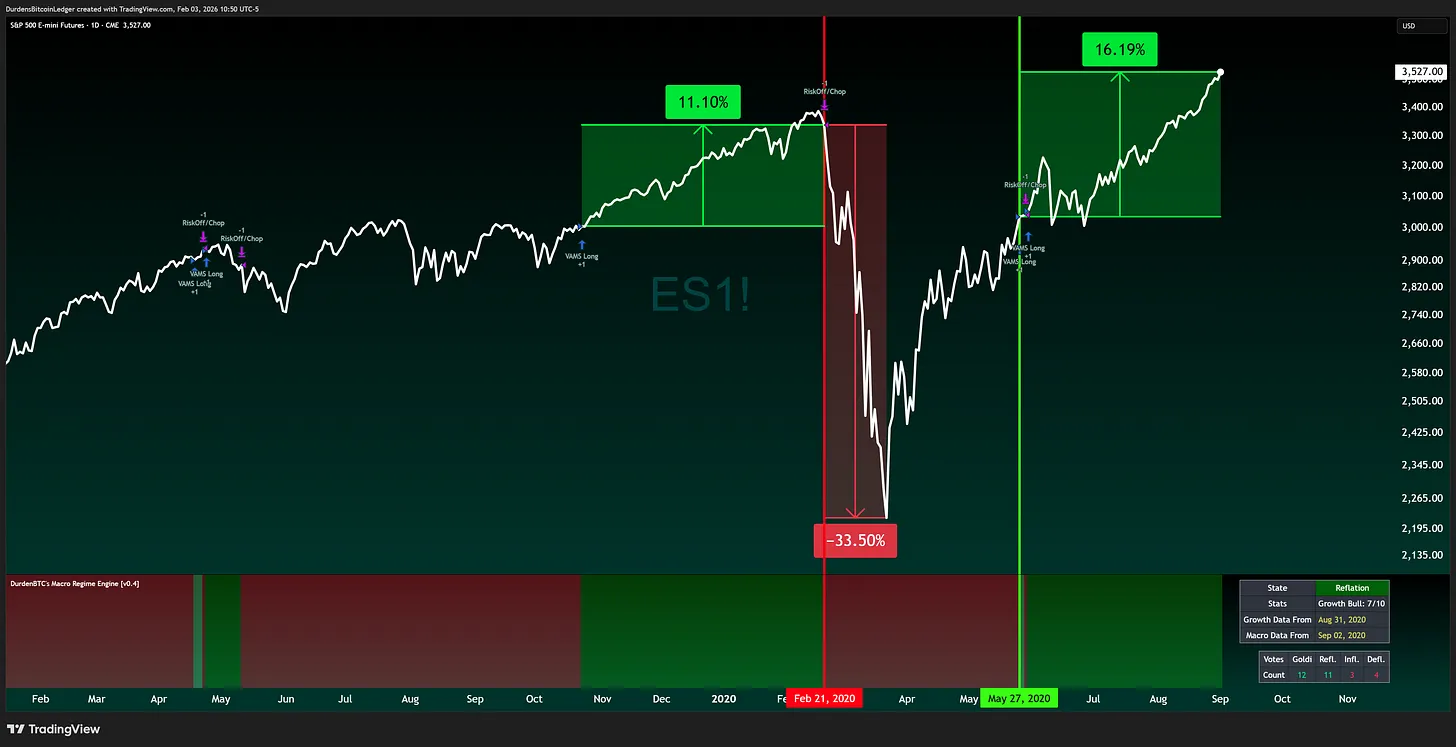
It held that position for 15 months.. through the entire reopening rally, through the vaccine rollout, through the melt-up into mid-2021. The trade returned +48.5% before the system exited again in September 2021, ahead of the 2022 bear market.
What This Tells You
The Macro Regime Engine didn’t time the top or the bottom. It entered the recovery about 36% above the absolute low. It exited the bull market a few weeks before the peak.
What it did was avoid the catastrophe in the middle.
A buy-and-hold investor who held through the COVID crash needed a 52% gain from the March bottom just to get back to the February high. And they had to endure the psychological reality of watching a third of their portfolio evaporate in three weeks.

The system was in cash, compounding from near the equity peak. When the recovery started, we had more capital to deploy. That advantage.. entering the next cycle from a higher base, is worth more than any individual trade.
This is the core thesis of the Macro Regime Engine: you don’t need to predict crises. You need to measure that the macro environment has turned hostile and step aside before the worst of the damage occurs. Cross-asset breadth gives you that measurement. No single chart can.
The Full Track Record
The COVID exit wasn’t a one-off. Over 26 years of backtesting on S&P 500 futures:
The system exited before the dot-com crash (September 2000)
It exited before the GFC waterfall (December 2007)
It exited the week before COVID (February 2020)
It exited near the top before the 2022 bear (November 2021)
75% win rate. 17:1 profit factor. 9.4% max drawdown across every major market crisis in modern history.
I share the regime signals with my subscribers. When the system flips, you’ll know what changed and why.
Disclaimer: This content is for educational and informational purposes only. It does not constitute financial advice. Past performance, whether backtested or live, does not guarantee future results.
Backtested results have inherent limitations and do not reflect actual trading. The author is not a licensed financial advisor. You are solely responsible for your own trading decisions.
Research and education, not investment advice. See the disclaimer.